NHA CONNECTIONS / DISTINCT SAMPLES, ONE RESEARCH SERIES
48games · 37 men / 11 women
17teams · 10 men / 7 women
1,630official assist records, including FT
756distinct directed assist pairs
THE QUESTION
Who makes a teammate’s role work?
Individual totals identify scorers, passers and rebounders. Their relationships reveal something different: which receivers repeatedly connect with a creator, who recovers whose misses, and whether one receiver depends on one generator or several. We followed those links through official event records, beyond the headline pairs.
Each carousel gives every team one story. This edition opens the full research desk: all 756 directed assist pairs, every team network, reciprocal links, common-receiver triangles and conservatively identifiable event sequences. Some are recurrent descriptions; others are questions for the next film session.
15 RESEARCH PERSPECTIVES / NOT A LEAGUE RANKING
What stands out — and what needs another look
Men’s recurrence and women’s early signals are read against their own samples. All 17 dossiers, including Asker and Ammerud Queens, are available below.
01 / BLNO MEN / Ammerud
One creator, several destinations
Cranston-Lown supplies 81 of 157 assist records (51.6%). Hadley is the outside story: 26 links, 17 on threes. Davidsen is almost as prominent: 25 links, with 20 twos and five FT records. Both recur in all seven common games. Hadley also feeds Horiuk ten times. The network therefore connects one central generator to different finishing profiles.
02 / BLNO MEN / Bærum Basket
A perimeter link and an emerging triangle
Mjøs–Øverås has 14 links, nine on threes, in eight common games. Mjøs also feeds Olsen ten times; Ellingsen contributes another seven links to Olsen. In the two games with Tendero Salom, Mjøs and Øverås all participating, Mjøs and Tendero each supply four links to Øverås: eight of his ten made FGs in that aligned sample.
03 / BLNO MEN / Centrum Tigers
Distributed creation, modest pair volume
Selboe leads the team with just 17 of 99 assist records (17.2%); Berbusmel follows with 16. Berbusmel–Eidholm has six links, but four arrive in one game. Selboe–Eidholm has four, each in a different match. The carousel chooses recurrence while the wider network explains Centrum better than one dominant duo.
04 / BLNO MEN / Frøya
Consistency and volume tell different stories
Hagberg–Johnson has 11 links and Hagberg–Månsson nine, both appearing in five of six common games. Johnson’s best game supplies five records, versus three for Månsson. Both links fall to six after removing their best game. Månsson is the less concentrated editorial choice; Johnson, Downs, Borg and Dalland remain important in the wider network.
05 / BLNO MEN / Fyllingen
One link in every common game
Davis–Ledoux has nine links, eight on threes, but six come in a single game and the pair connects in just two of five common appearances. Davis–Nilsen supplies one link in each of five games. These are distinct stories: concentrated volume and small, distributed recurrence. Barnies is another common receiver for Ledoux and Davis.
06 / BLNO MEN / Gimle
Creation plus fast follow-up scoring
Espe–Savic has eight official links in four common games: six twos and two FT records. Savic also initiates six strictly identified defensive-event-to-Mullins scores within seven seconds; four survive a five-second window. Five of the six occur against Nidaros on 17 October. The temporal pattern is much more concentrated than the passing link.
07 / BLNO MEN / Kongsberg Miners
The pair opens a triangle
Cookson recovers five Anderson misses, all after threes, within six seconds; four fit three seconds. In the passing network, Cookson and Anderson each feed Borg eight times. These 16 records contain 15 assisted field goals out of Borg’s 29 in six common games. Two generators share one receiver; this is not a chain of passes.
08 / BLNO MEN / Nidaros Jets
A relationship in more than one phase
Leraand recovers seven Øvermo misses within six seconds, five after threes. Øvermo also assists eight Leraand field goals. In the reverse continuation, Øvermo makes two identifiable threes within 14 seconds after Leraand ORBs, with two other first outcomes recorded as misses. Those four classified outcomes sit inside a denominator of 25 Leraand offensive rebounds over ten common games.
09 / BLNO MEN / Tromsø Storm
Creation, reception and recovery
Lange–Denbow supplies 26 assist records in all six common games; 20 remain after the best game is removed. Sitton adds 12 links to Denbow. In their six-game triangle, the two creators assist 36 of Denbow’s 76 made FGs. Solem adds a different contribution: seven identified offensive rebounds after Denbow misses, all within three seconds. Lange also feeds lower-minute Berntsen 11 times in nine common games.
10 / BLNO MEN / TNT Towers
A repeatable link within a spread network
Næss–Prus has six links and appears in five of six common games; four remain without its best game. Shaka–Klemmetsby supplies five in eight games, and Næss also feeds Klemmetsby. Næss accounts for 25 of the team’s 103 assist records (24.3%), a central role in a broadly distributed network.
11 / BLNO WOMEN / Bærum Basket
Two games, deliberately cautious language
Havnes–Dragøy has three links: one two and two threes, across both Bærum games. They account for three of Dragøy’s five field goals. Deisz adds another assisted FG, but four of five does not demonstrate settled season-long dependence after two games. The refreshed sample includes the 25 October match.
12 / BLNO WOMEN / Frøya
One creator, two finishing profiles
Cluse–Haukenes supplies seven links, five on threes. Cluse–Lops also supplies seven, all on twos. Both links appear in every common game. Haukenes adds five records to Lops, including two FT records: Cluse and Haukenes together assist ten of Lops’ 14 field goals over three games. Cluse–Collier also has three identifiable offensive recoveries at six seconds, rising to four at eight.
13 / BLNO WOMEN / Skjetten
Keep the concentration visible
Julie–Amalie Engebretsen has four links, split into two twos and two threes. Three come in one game, leaving one after its removal. Julie also feeds Aslan three times; Aslan averages just 2.33 FGA in the three-game exposure sample. This is another lower-shot-volume connection worth following.
14 / BLNO WOMEN / Ullern
Recovery is one part of the network
Tveiten recovers four Underwood misses, two after twos and two after threes. All fit three seconds, but they occur in only two of four games. Halvorsen–Johansen has five assist links across all four games; Torresani adds five more. Together they assist ten of Johansen’s 15 FGs. Torresani–Chol adds five records to a receiver averaging 11.05 minutes and 2.75 FGA.
15 / BLNO WOMEN / Ulriken Eagles
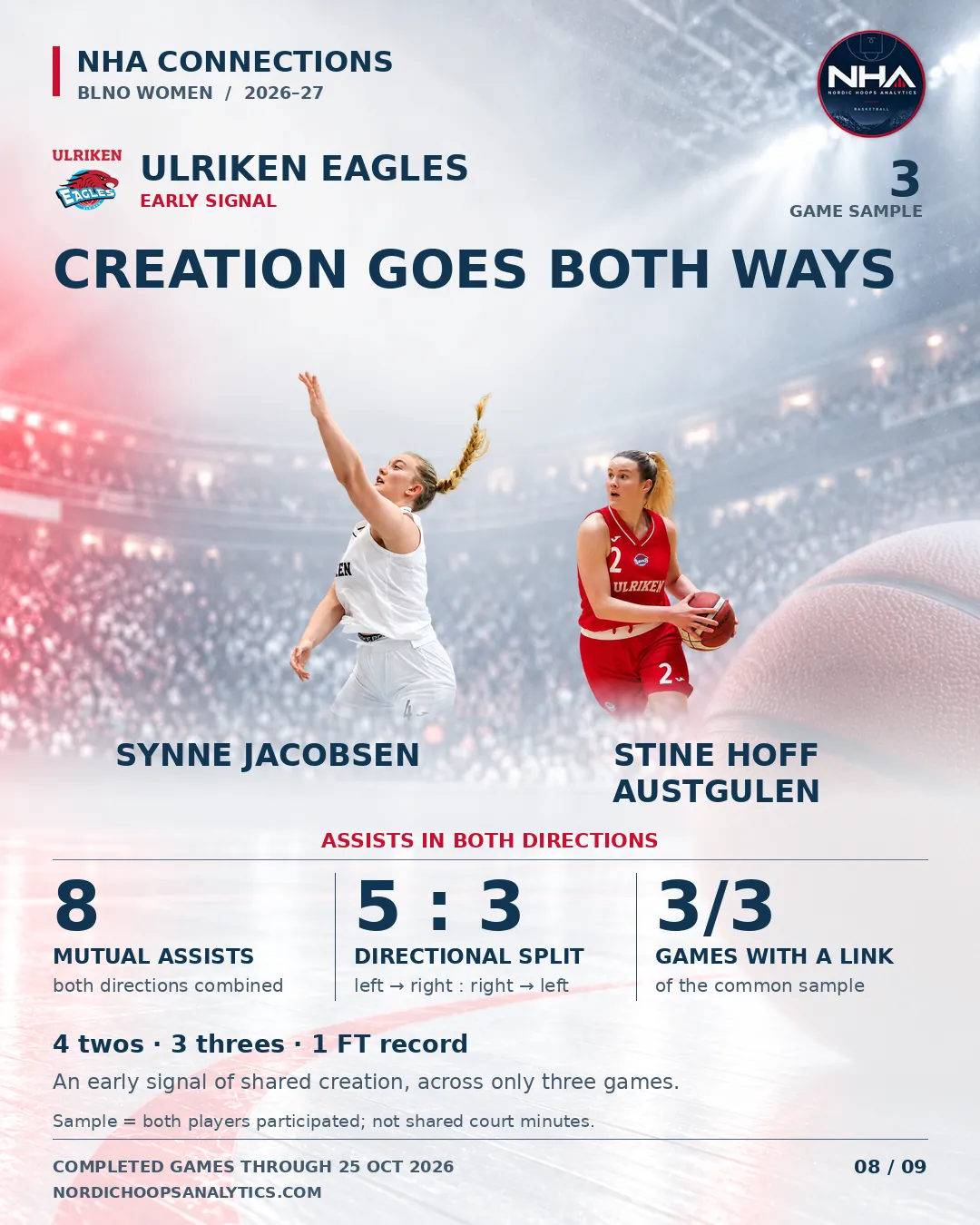
Creation goes both ways
Jacobsen and Hoff Austgulen exchange eight assist records, split five to three, including one FT record. At least one direction appears in each of the three games. Removing the four-link best game leaves four across the other two. Sanford also supplies four links to Jacobsen; Jacobsen and Hoff Austgulen each feed Holm three times.
ALL 17 TEAMS / INTERACTIVE RESEARCH DESK
Read a team as a network
TEAM DOSSIER
Tromsø Storm
9team games
Creation, reception and recovery
Lange–Denbow supplies 26 assist records in all six common games; 20 remain after the best game is removed. Sitton adds 12 links to Denbow. In their six-game triangle, the two creators assist 36 of Denbow’s 76 made FGs. Solem adds a different contribution: seven identified offensive rebounds after Denbow misses, all within three seconds. Lange also feeds lower-minute Berntsen 11 times in nine common games.
Confidence & limit: Tromsø has nine team games, while the Lange–Denbow pair has six common games. These denominators must stay separate.
188team assist records
45.7%leading generator’s share
6carousel pair common games
26carousel assist records
Leading generators
Johannes Lange86 · 45.7%
Grant Sitton22 · 11.7%
Anders Solem21 · 11.2%
Garrett Denbow13 · 6.9%
Isak Nilsen12 · 6.4%
Leading recipients
Garrett Denbow51 · 27.1%
Anders Solem27 · 14.4%
Grant Sitton27 · 14.4%
Johannes Lange20 · 10.6%
Isak Nilsen20 · 10.6%
Team shares use all team assist records, including games a player missed. Active-game denominators for generators are in the download. Recipient totals count assist records, not points.
Arrows show direction; numbers show official assist records. The ten largest directed links are displayed for legibility. Select a link to inspect it. The complete network remains in the table and downloads.
58 observed pairs, including single observations. Common games require both players to have participated. Temporal categories exclude the period-corrupted 11 October game.
Tromsø Storm · Assist → finish
Connection · select for detail
Records
Common GP
Finishing / context
FG share / recurrence
26
6
9 two / 16 three / 1 FT
32.9% (25/76)
19
9
9 two / 6 three / 4 FT
51.7% (15/29)
12
6
9 two / 2 three / 1 FT
14.5% (11/76)
11
7
4 two / 7 three / 0 FT
28.9% (11/38)
11
9
11 two / 0 three / 0 FT
47.8% (11/23)
10
9
3 two / 5 three / 2 FT
11.4% (8/70)
10
9
0 two / 10 three / 0 FT
22.7% (10/44)
4
6
1 two / 3 three / 0 FT
12.9% (4/31)
4
7
0 two / 2 three / 2 FT
5.3% (2/38)
4
6
1 two / 3 three / 0 FT
30.8% (4/13)
3
7
2 two / 1 three / 0 FT
7.9% (3/38)
3
9
2 two / 1 three / 0 FT
15.8% (3/19)
3
9
2 two / 1 three / 0 FT
15.8% (3/19)
3
9
1 two / 2 three / 0 FT
6.8% (3/44)
3
6
2 two / 1 three / 0 FT
3.9% (3/76)
3
9
0 two / 3 three / 0 FT
4.3% (3/70)
3
6
0 two / 2 three / 1 FT
2.6% (2/76)
3
7
1 two / 2 three / 0 FT
8.1% (3/37)
3
2
0 two / 3 three / 0 FT
10.7% (3/28)
3
6
0 two / 3 three / 0 FT
37.5% (3/8)
2
9
0 two / 2 three / 0 FT
2.9% (2/70)
2
2
0 two / 0 three / 2 FT
0.0% (0/1)
2
7
2 two / 0 three / 0 FT
40.0% (2/5)
2
7
0 two / 2 three / 0 FT
4.0% (2/50)
2
6
0 two / 2 three / 0 FT
2.6% (2/76)
2
7
0 two / 1 three / 1 FT
2.6% (1/38)
2
7
2 two / 0 three / 0 FT
9.1% (2/22)
2
6
1 two / 1 three / 0 FT
4.5% (2/44)
2
3
2 two / 0 three / 0 FT
16.7% (2/12)
1
1
0 two / 1 three / 0 FT
16.7% (1/6)
1
1
0 two / 1 three / 0 FT
14.3% (1/7)
1
2
0 two / 1 three / 0 FT
33.3% (1/3)
1
9
0 two / 0 three / 1 FT
0.0% (0/19)
1
5
1 two / 0 three / 0 FT
4.8% (1/21)
1
4
1 two / 0 three / 0 FT
100.0% (1/1)
1
5
0 two / 1 three / 0 FT
5.6% (1/18)
1
7
1 two / 0 three / 0 FT
4.8% (1/21)
1
5
1 two / 0 three / 0 FT
12.5% (1/8)
1
9
1 two / 0 three / 0 FT
2.3% (1/44)
1
7
1 two / 0 three / 0 FT
20.0% (1/5)
1
6
1 two / 0 three / 0 FT
10.0% (1/10)
1
6
1 two / 0 three / 0 FT
3.4% (1/29)
1
6
0 two / 1 three / 0 FT
1.3% (1/76)
1
6
0 two / 1 three / 0 FT
4.8% (1/21)
1
9
0 two / 0 three / 1 FT
0.0% (0/29)
1
7
1 two / 0 three / 0 FT
7.1% (1/14)
1
5
0 two / 1 three / 0 FT
2.3% (1/43)
1
9
1 two / 0 three / 0 FT
4.3% (1/23)
1
3
0 two / 1 three / 0 FT
20.0% (1/5)
1
3
0 two / 1 three / 0 FT
5.6% (1/18)
1
7
0 two / 1 three / 0 FT
2.6% (1/38)
1
3
0 two / 1 three / 0 FT
5.6% (1/18)
1
3
1 two / 0 three / 0 FT
16.7% (1/6)
1
9
1 two / 0 three / 0 FT
3.4% (1/29)
1
7
1 two / 0 three / 0 FT
5.9% (1/17)
1
3
0 two / 1 three / 0 FT
20.0% (1/5)
1
3
0 two / 1 three / 0 FT
20.0% (1/5)
1
6
0 two / 1 three / 0 FT
12.5% (1/8)
CONNECTION DETAIL / EXPLICIT ASSIST
Johannes Lange → Garrett Denbow
26official assist records
6/6connected / common games
4.33per common game
20without the best game
Best-game concentration: 23.1%. Removing it leaves 4.00 links per remaining common game. Participation does not imply shared minutes.
9 twos · 16 threes · 1 FT records. Associated recorded points: 67. Receiver FG share: 25/76 (32.9%), with FT records excluded from that numerator. FT clock groups: 1; records in a group may belong to one trip. Links outside ≥20-point-margin contexts: 19/26; excluding late fourth-quarter wide-margin events: 21. These are descriptive checks, not opponent or pace adjustments.
Temporal examples may also show events outside the strict window: read the stated gap. All records and thresholds are preserved in the full download.
FROM RECORDS TO SCOUTING QUESTIONS
Complementarity has more than one shape
The triangle can explain more than the biggest pair
Anderson–Cookson–Borg, Lange–Sitton–Denbow and Cluse–Haukenes–Lops describe two generators sharing a receiver. Every triangle is aligned to games in which all three participated. Adding two complete-season pair totals without aligning the samples would distort concentration. There is no evidence of an extra pass, a passing chain or a secondary assist.
A recovery is not automatically creation
Cookson after Anderson misses, Solem after Denbow misses, and Tveiten after Underwood misses show complementary events. This does not assign positive value to a miss, measure the difficulty of the rebound, or identify who created rebounding position. Strict ordering captures minimum identifiable counts and discards ambiguous timestamps.
A second chance is not necessarily a put-back
After an ORB, a teammate’s later score may follow circulation, movement or an unrecorded pass. Øvermo’s two threes after Leraand offensive rebounds belong to four classified first outcomes, inside a sample of 25 Leraand ORBs. Two divided by four would be an invalid pair shooting percentage: unclassified continuations are absent from that denominator.
Individual totals can overstate the stability of a link
Davis–Ledoux produces eight assisted threes but six of its nine records come in one game. Berbusmel–Eidholm is Centrum’s largest directed pair at six, with four in one game. Havnes–Dragøy’s 60% receiver FG share comes from only three of five made FGs across two games. The events are real; claims of settled season-long chemistry would exceed the evidence.
The quieter roles still matter
Torresani–Chol’s five records, Julie Engebretsen–Aslan’s three and Lange–Berntsen’s eleven extend the study beyond the headline scorers. Minutes and FGA describe exposure; low minutes are not a verified substitute designation. Starting status cannot be validated across every game, so no blanket starter/bench labels are invented.
Protection and recovery: one event stays one event
The strict block→defensive-rebound scan finds 36 pairs, each with only one ≤6-second observation. For example, Downs’ block followed by Hagberg’s rebound on 18 September is traceable to Q1, 4:34 remaining: action #81022056, then #81022140 two seconds later. This illustrates a film question, not a recurring partnership.
Editorial follow-up
The strongest publication angles are different: recurrent perimeter creation at Tromsø and Ammerud; Kongsberg’s common receiver rather than only its rebound pair; Fyllingen’s consistency-versus-volume contrast; Centrum’s distributed network; and provisional women’s stories around Frøya’s finishing profiles, Ulriken’s reciprocity and Ullern’s lower-volume recipients. Film should test the tactical mechanisms before those are named.
THE EDITORIAL EDITION
NHA Connections · both carousels
One pair story per team, arranged for variety rather than rank. Women use the approved light arena background with a muted ball and visible samples.
REPRODUCIBILITY / SOURCES / LIMITS
What this study can demonstrate
Coverage and validation
The 44-game archive was updated with the four Sunday matches: Frøya–Ammerud (8426717), Bærum–TNT (8426790), Ulriken–Ullern (8426664) and Bærum–Ammerud Women (8426668). This dated snapshot covers 48 games through 25 October: 37 men and 11 women. Official schedules checked on 27 October contained no later completed results.
45,037 incident rows resolve to 20,584 parent actions; parent and child records are not independent actions. Player IDs and team membership are matched to the official player records. All 48 scores and player FG/FGA, FT/FTA, assists, ORB, DRB, steals, blocks and turnovers reconcile. No within-game duplicate incident IDs were found.
Ammerud–Skjetten Women (8426662, 11 October) has inconsistent period allocation. Its score and player totals reconcile: explicit assists are retained, while temporal sequences and their common-game denominators exclude that game.
Assists, points and denominators
All official assists are retained, including those attached to made free throws. Twos, threes and FT records remain separate. Several FT records may come from one foul sequence, so they must not be called independent passes or fouls. Clock groups flag possible clustering but do not uniquely identify foul trips. Associated points sum linked scoring values without adding parent and child points twice.
Receiver FG share = partner-assisted twos and threes ÷ all receiver made FGs in exactly the same common games. Rate = records ÷ common participation games, including zero-link games. Best-game sensitivity removes the largest link count and recomputes the remaining rate. Neither measure estimates pass accuracy, shot quality or pair efficiency.
Miss→ORB uses all shooter FG misses in the same eligible games as its opportunity denominator. After-ORB uses all rebounder ORBs. Unclassified continuations are not recorded failures, and the identified subset cannot be used as all attempted opportunities.
Temporal ordering and window sensitivity
Order uses period and elapsed game-clock seconds, not incident ID order to break ties. Ambiguous simultaneous events are excluded; boundaries are not crossed. Example clocks show time remaining converted from elapsed time.
Miss→ORB requires one missed two or three followed by the next relevant timestamp containing one same-team offensive rebound, with a positive gap: sensitivity at 3/6/8s. A contemporaneous block can accompany the missed shot. After ORB follows the first identifiable shot, turnover, rebound or foul within 24s, interrupted by timeout; makes are compared at 6/14/24s. Multiple simultaneous first outcomes are rejected. An opponent defensive foul does not identify the fouled recipient.
Defence→score requires a lone defensive rebound or steal followed by the next relevant event, a teammate made FG, at 5/7/10s. Block→recovery permits the blocked shot at the same time as the block but requires a later lone same-team defensive rebound at 3/6s. These are event sequences, not verified passes, transition possessions or named plays.
Minutes, opponent context and uncertainty
Complete lineup reconstruction passes substitution and official-minute checks in only seven of 48 games. No pair shared minutes, on/off or possession ratings are published. Playing in the same match is not equivalent to sharing court time. The lineup audit is downloadable.
Every pair distribution shows opponents and final scores. Assist details also show sensitivity to ≥20-point-margin contexts and late fourth-quarter wide margins. These are descriptive checks, not causal adjustments for pace, opponent strength, role, minutes or overtime. The temporal scan uses four regulation periods and excludes overtime extensions.
Women have only two to four team games. Rates per game do not remove that uncertainty. Removing the best game is a sensitivity check, not a confidence interval. No opaque composite partnership score is used.
Official sources and film priorities
Sources: NBBF / BasketLive, tournament IDs 449378 (Men) and 449376 (Women), MatchIncidents and basketball/match/Players records. Originals are preserved separately from calculations. The full download includes all pairs, thresholds, audits and action references.
Film priorities: examine the origin of Hadley’s and Haukenes’ assisted threes, receiver movement in the Borg and Lops triangles, positioning around Cookson/Solem/Tveiten recoveries, and whether the concentrated Savic–Mullins sequences recur against other opponents. Pick-and-roll, screens, spacing, outlet passes and defensive quality cannot be identified from these logs alone.
Explore free BLNO statistics, then request opponent preparation, post-game analysis, a team report or a player report. Scope, price and delivery are agreed before payment.